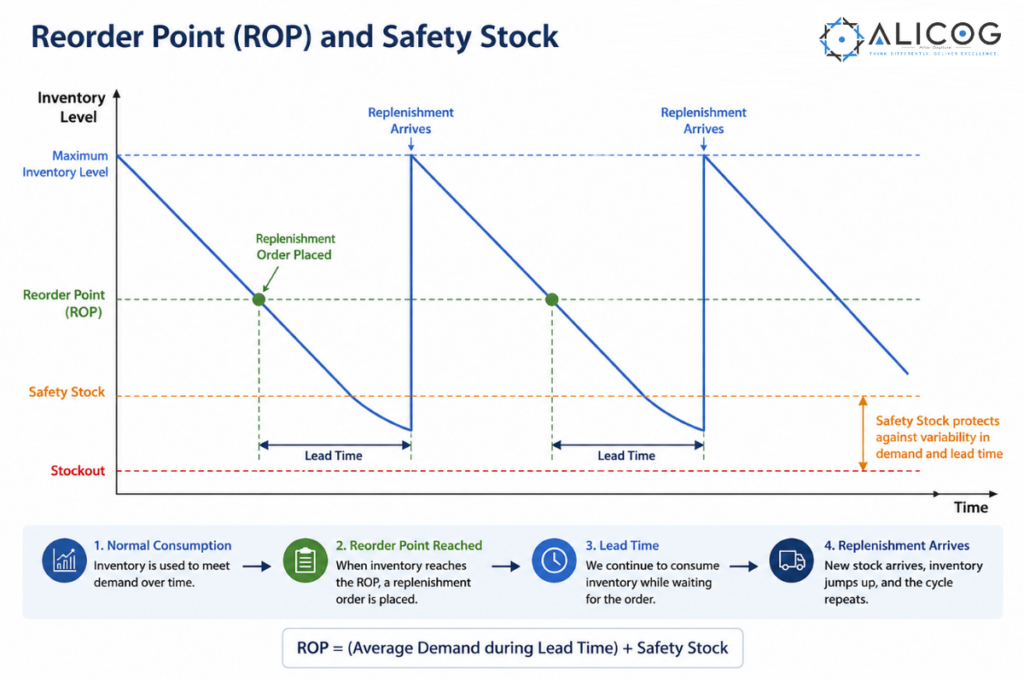
Inventory planning is a constant balancing act. Organizations need enough stock to meet customer demand without tying up excessive working capital or increasing storage costs. One of the simplest and most effective planning parameters for achieving this balance is the Reorder Point (ROP). Although often viewed as a basic inventory setting, the reorder point plays a strategic role in supply chain performance. When properly configured, it helps organizations replenish inventory at the right time, improve service levels, reduce emergency purchasing, and create a more resilient and efficient supply chain. For companies undergoing supply chain transformation, reorder point planning remains a valuable complement to more advanced planning methods.
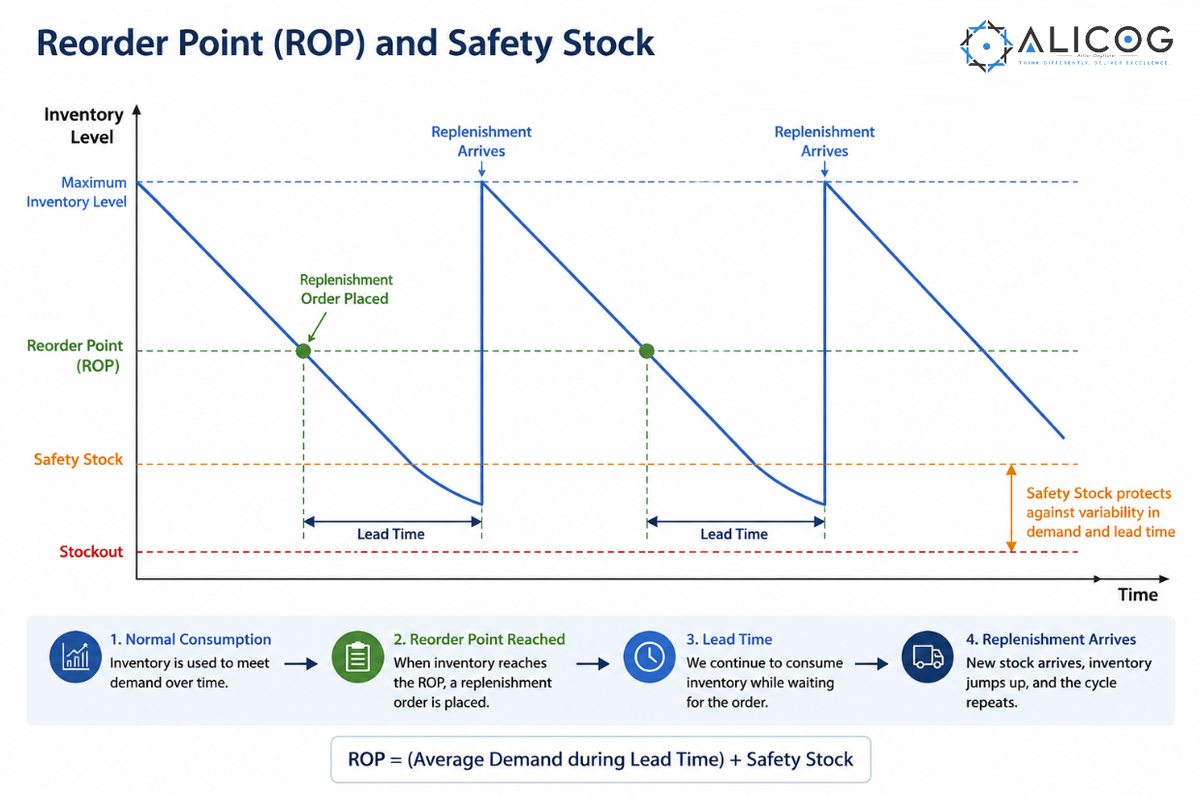
The reorder point is the inventory threshold that triggers replenishment. When available inventory reaches this predefined level, a purchase or production order should be initiated so that new stock arrives before existing inventory is exhausted. The reorder point determines when to replenish inventory, while separate planning policies determine how much to replenish.
Reorder point planning is widely used across manufacturing, distribution, retail, healthcare, and maintenance operations. It is particularly effective for materials with stable consumption patterns and predictable supplier lead times. Packaging materials, maintenance spare parts, consumables, replacement parts, and standard finished goods are common candidates because their demand can be estimated with reasonable confidence.
Not every inventory item should be managed using a reorder point. The method performs best where demand is relatively consistent, lead times are reliable, and inventory is monitored continuously through an ERP or inventory management system. Products with highly variable demand, engineer-to-order environments, project procurement, or production driven by Material Requirements Planning (MRP) are generally better served by alternative planning approaches.
The reorder point combines two key elements: expected demand during supplier or production lead time and a safety stock buffer that protects against uncertainty.
Reorder Point = Demand During Lead Time + Safety Stock
Demand during lead time reflects expected consumption while replenishment is in progress, while safety stock absorbs variability in demand or supplier performance. Organizations with mature planning processes often calculate safety stock using statistical methods that align inventory levels with target service levels.
A common misconception is that the reorder point determines both when and how much to order. In reality, these are separate decisions. The reorder point identifies the appropriate time to replenish inventory, while the replenishment quantity is determined by policies such as Economic Order Quantity (EOQ), fixed lot sizes, supplier constraints, production batch sizes, or business-specific inventory strategies.
When implemented as part of a structured inventory planning process, reorder point planning improves material availability, reduces stockouts, lowers emergency purchasing, supports better supplier collaboration, and optimizes inventory investment. Automated replenishment also reduces manual planning effort, allowing planners to focus on exceptions and continuous improvement rather than routine ordering decisions.
The effectiveness of reorder point planning depends on data quality and governance. Inaccurate inventory records, outdated demand assumptions, changing supplier lead times, and poorly maintained safety stock values can quickly reduce planning accuracy. Organizations should therefore review planning parameters regularly and align them with evolving business conditions.
Successful organizations treat reorder point planning as an ongoing process rather than a one-time configuration. Demand patterns, supplier performance, service level objectives, and inventory policies should be reviewed periodically. Integrating reorder point calculations within ERP systems, maintaining accurate master data, segmenting inventory according to business value, and monitoring inventory performance through KPIs all contribute to more reliable replenishment decisions.
Modern supply chain transformation is not about replacing proven planning concepts with increasingly complex algorithms. Instead, it is about selecting the right planning method for each inventory segment. Reorder point planning continues to provide significant value for stable, high-volume items, while MRP, demand planning, or advanced planning solutions can manage more dynamic demand patterns. Combining these approaches enables organizations to build planning processes that are both efficient and resilient.
The reorder point remains one of the most effective inventory planning parameters for balancing product availability with inventory investment. While straightforward in principle, its success depends on accurate data, disciplined governance, and regular review of planning assumptions. Organizations that integrate reorder point planning into a broader supply chain transformation strategy can improve service performance, optimize working capital, and create a more responsive supply chain. Rather than being a simple inventory threshold, the reorder point is a practical decision-making tool that supports operational excellence and long-term business performance.
Expert en Supply Chain et SAP S/4HANA avec plus de 20 ans d'expérience industrielle. Fondateur d'ALICOG, cabinet de conseil spécialisé en transformation supply chain.
En savoir plus →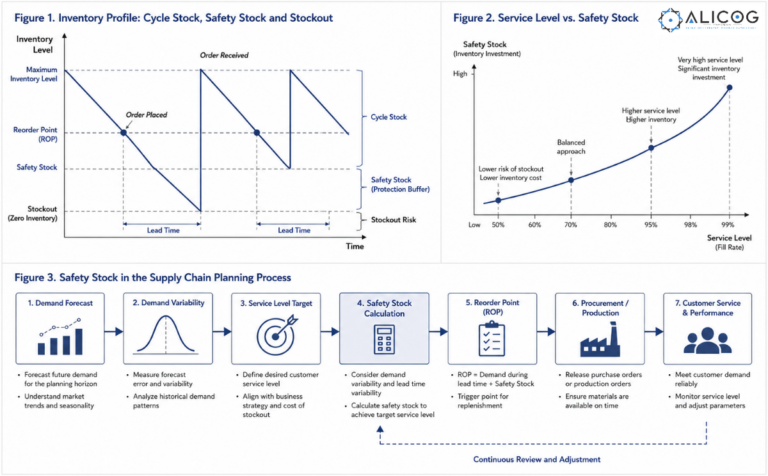

Premier échange de 30 min avec un expert ALICOG — sans engagement.